
"coffee flavor classification"
4000 article(s) found

Taste characteristics of Brazilian yellow bourbon coffee beans taste classification flavor description introduction of varieties in manor producing areas
Taste characteristics of Brazilian yellow bourbon coffee beans taste classification flavor description the present situation of variety introduction coffee in the manor producing area has been naturally favoured and has been cultivated in new places inland. Panama became famous as a new coffee producing place in Brazil after the war, and because its natural conditions are not superior, it is still inferior in quality compared with that produced in Sao Paulo. Now in the northern part of Sao Paulo

Nomenclature, classification and grade of 90 + boutique coffee
Follow Cafe (official Wechat account vdailycom) found that Beautiful Cafe opened a small shop of its own. When I talked to a lot of people about 90 + beans recently, I found that many people still don't know the naming, classification and grade of 90 +. If they don't know something about their products, their official website is completely unable to answer what their products are, how to name them and how to classify them.
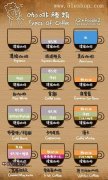
Common sense Coffee Twelve Classification and preparation of Coffee
There are many categories of coffee, and each coffee combination is also different, each kind of coffee, has its own unique taste and preparation method. What do you know about the classification and combination of those coffees? The basic classification of coffee is divided into twelve categories. Each has its own way of preparation and unique taste. Which one would you like? 1. Espresso, Italian

High-quality Indonesian coffee raw bean classification standard brand altitude planting environment origin
Boutique coffee beans 1. Generally speaking, coffee is not classified according to altitude in countries near the equator because coffee is grown at a higher altitude. In addition, if it is picked by hand and processed by washing, it will not be graded by bad points because there are few immature beans and sundries mixed in. Therefore, the size of the sieve number is generally used as the grading standard. Such as: Colombia, Tanzania

Understand the basic knowledge of coffee classification of coffee
Classification of coffee: coffee trees can be roughly divided into five types, of which Arabica and Robusta are more common. Arabica species, which account for more than 70% of the world's total output, are generally grown on slopes above 900 meters above sea level and are mostly found in tropical high-altitude areas such as Central and South America, East Africa, Southeast Asia and Hawaii. Its pleasant aroma and rich taste

Coffee Bean Classification Standard Coffee Bean AA17 What is the judgment of defective beans and ten categories
Each producing country has its own classification and rating charts, which are also commonly used to set minimum standards for exports. It has the best flavor. The size and size distribution of coffee beans also have an impact on the optimization of roasting conditions. Coffee beans in coffee-producing countries are often determined by the following factors: 1. Altitude 2. Region 3. Plant variety 4. Method of preparation (

Classification of taste characteristics of fine coffee
What the barista barista training school wants to show you today is the taste characteristics of fine coffee. The so-called characteristics refer to the differences in taste and flavor caused by the differences in the growing environment and varieties of various coffee beans after they have been properly roasted. The sour coffee beans, especially the high-quality new beans, have the best baking degree, while the bitter coffee beans should be roasted.

How to classify coffee beans A brief introduction to the classification standard of Ethiopian defective beans
Professional coffee knowledge exchange more coffee bean information please follow the coffee workshop (Wechat official account cafe_style) front street-defective bean classification system this is the earliest classification method, the main representative countries that use the defective bean proportion method are Ethiopia, Indonesia and so on. Indonesian beans are mainly divided into six grades, namely G1~G6. Ethiopian coffee beans are graded with 300g coffee beans.

Introduction to variety classification of Ethiopian coffee beans by description of taste and flavor
Ethiopian coffee classification Ethiopian beans are easy to recognize, mostly small and pointed long beans, known as longberry, and often mixed with small oval-shaped short beans, called shortberry, look uneven in size and appearance. The commercial bulk beans of Grade4 or Grade5 are mostly mixed with hundreds of different crystal seeds in different producing areas, so the bean phase

Classification of taste characteristics of fine coffee in coffee encyclopedia
The taste characteristics of fine coffee, the so-called characteristics, refers to the differences in taste and flavor caused by the growth environment and variety differences of all kinds of coffee beans after proper roasting. The sour coffee beans, especially the high-quality new beans, have the best baking degree, while the bitter ones have a lighter baking degree, and then the sweet details are mostly selected beans produced in the highland.

Special flavor Kenyan coffee Flavor Taste Manor Features Berman Manor
This is the earliest classification method and is still in use in many parts of Brazil. The method of identification is to take a random sample of 300 grams and put it on black paper, because black paper can best avoid reflection. Then, professional appraisers carefully inspect the samples to find defective beans and accumulate different scores according to the types of defects. For example, 1 black bean counts as 1 point, 1 small stone counts as 1 point, and 1 large stone counts as 1 point.

Classification and taste of Burundian coffee beans
The classification and taste of Burundian coffee beans there are striking similarities between Burundian coffee and neighboring Rwanda, and the coffee produced in these two countries is often confused. Burundian coffee is mainly grown in bourbon, with traditional wet processing of coffee cherries. Its boutique coffee is characterized by elegant sweetness and bright citrus aromas. This batch belongs to the bourbon species micro batch.

Classification of coffee by the National Standard for Coffee Botany
There are more than 60 types of coffee, but there are roughly two types of coffee grown on a commercial scale, one is Arabica, accounting for about 70% of the world's coffee planting area; one is Robasta, accounting for about 30% of the world's coffee planting area. According to the classification of coffee by China's national standards, it is mainly divided into the following five varieties. 1. Arabica coffee, i.e. Arabian species. origin

Coffee is classified like this. Explore the secret and classification of coffee bean names.
Professional coffee knowledge exchange More coffee bean information Please pay attention to coffee workshop (Weixin Official Accounts cafe_style) When buying coffee beans, in addition to seeing the name of coffee origin in the packaging or text introduction, sometimes you will see English and numbers, G1, G2, G3, AA, PB, SHB, SHG, HB, etc. Have you ever been confused about what these English or numbers represent? they

Exploring the secrets and classification of coffee bean names: how to distinguish the quality of coffee beans
Communication of professional baristas Please pay attention to the coffee shop (Wechat official account cafe_style) when buying coffee beans, you will sometimes see English and numbers, G1, G2, G3, AA, PB, SHB, SHG, HB, etc., in addition to the name of the coffee producing area in the packaging or in the text introduction. Have you ever wondered what these English or numbers represent? What's the difference between them?

Classification characteristics of Colombian Coffee Flavor description Grinding scale
Colombian Coffee grading characteristics treatment Flavor description Grinding scale suitable climate in Colombia provides a real natural pasture for coffee. Coffee trees in Colombia are mainly cultivated in the Andes, on steep slopes about 1300 meters above sea level, where the annual temperature is about 18 degrees Celsius, annual rainfall is 2000 to 3000 mm, latitude 1-11-15, west.

Boutique coffee beans: a detailed introduction to the classification and taste of famous coffee beans in Asia
Indonesia Sumatra SumatraTobaBlueEyeMandheling Coffee: Asian countries: northern Sumatra, Indonesia: TobaLake (the mountain lake near Lake Dorba is clear and blue, so it is named after Blue Eye Manning). Flavor: full of ripe comprehensive fruit flavor, low acidity, creamy aroma, long flavor! Golden Manning Coffee Indonse

Classification of coffee beans varieties characteristics of Arabica coffee beans correct drinking method of Rosa Coffee
Professional coffee knowledge exchange more coffee bean information please follow the coffee workshop (Wechat official account cafe_style) coffee is how to classify? From the crops in the mountains to the drinks in our hands, coffee has gone through five steps: planting, harvesting, processing, roasting and extraction. All the classifications we have seen so far are basically based on the no in these steps.
Brazilian coffee bean producing area, Brazilian coffee bean grade
Following Cafe Review (official Wechat account vdailycom) found that Brazilian Coffee, which opened a small shop in Fairview Cafe, had a low sour taste, matched with the sweet and bitter taste of coffee, and had a slight grassy aroma, with a slightly bitter taste in the fragrance, smooth taste and pleasant aftertaste. There are no outstanding advantages for Brazilian coffee.

Coffee Art and Technology-Coffee plants and Classification-Why is the flavor of Katim coffee beans so bad?
Professional coffee knowledge exchange more coffee bean information please follow coffee workshop (Wechat official account cafe_style) Katim coffee beans coffee plants and plant classification coffee botanical classification coffee Rubiaceae characteristics of three kinds of coffee beans let us botanically subdivide coffee plants. Coffee is a shrub, part of the Rubiaceae family. Classification of 73